Assets
An Asset is a unit of value that can be transferred from one account to another using notes.
What is the purpose of an asset?
In Miden, assets serve as the primary means of expressing and transferring value between accounts through notes. They are designed with four key principles in mind:
-
Parallelizable exchange:
By managing ownership and transfers directly at the account level instead of relying on global structures like ERC20 contracts, accounts can exchange assets concurrently, boosting scalability and efficiency. -
Self-sovereign ownership:
Assets are stored in the accounts directly. This ensures that users retain complete control over their assets. -
Censorship resistance:
Users can transact freely and privately with no single contract or entity controllingAssettransfers. This reduces the risk of censored transactions, resulting in a more open and resilient system. -
Fee payment in native asset:
Transaction fees are paid in the chain's native asset as defined by the current reference block's fee parameters. See Fees.
Native asset
All data structures following the Miden asset model that can be exchanged.
Native assets adhere to the Miden Asset model (encoding, issuance, storage). Every native Asset is encoded using 32 bytes, including both the ID of the issuing account and the Asset details.
Issuance
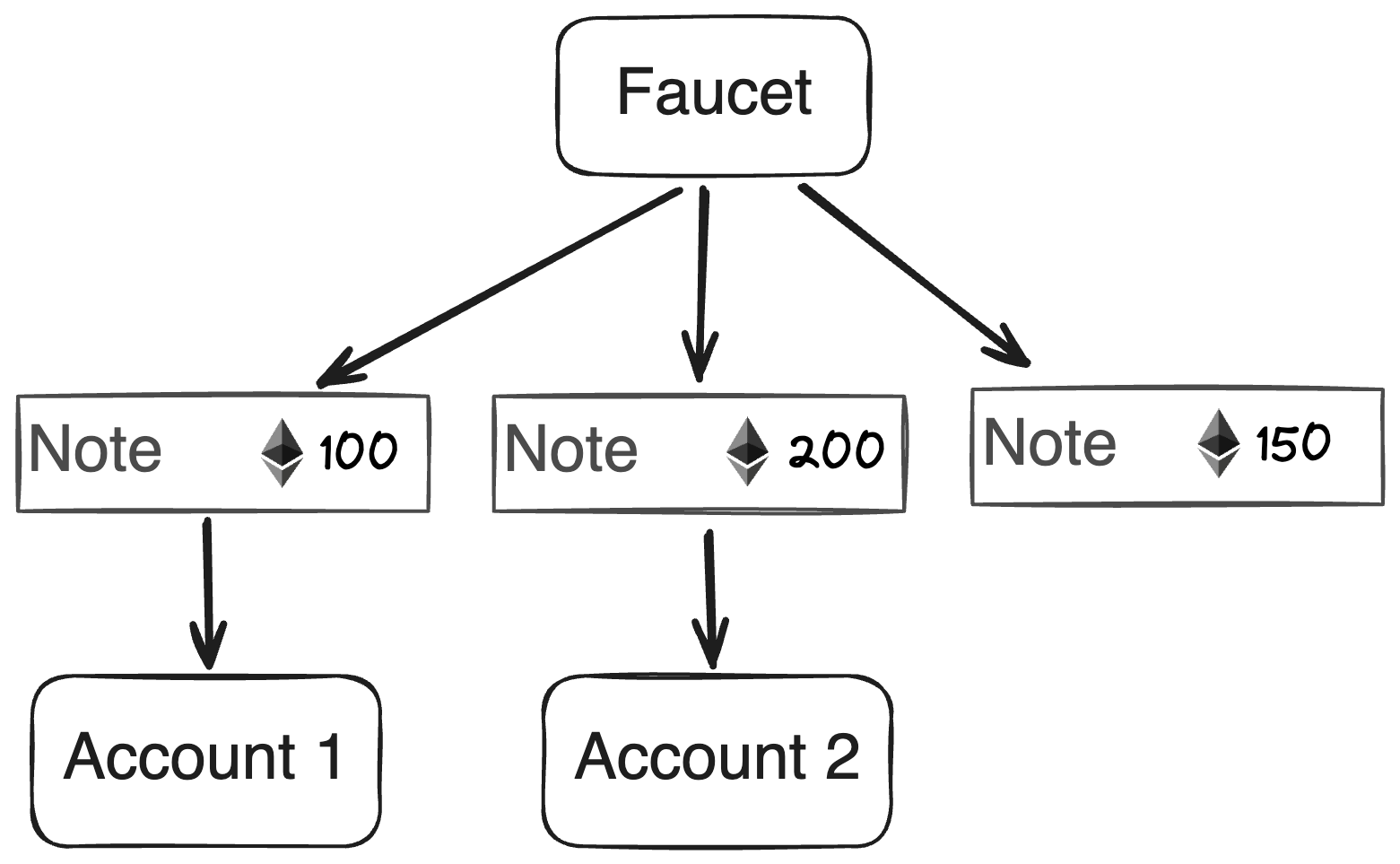
Only faucet accounts can issue assets.
Faucets can issue either fungible or non-fungible assets as defined at account creation. The faucet's code specifies the Asset minting conditions: i.e., how, when, and by whom these assets can be minted. Once minted, they can be transferred to other accounts using notes.
Type
Fungible asset
Fungible assets are encoded with the amount and the faucet_id of the issuing faucet. The amount is always or smaller, representing the maximum supply for any fungible Asset. Examples include ETH and various stablecoins (e.g., DAI, USDT, USDC).
Non-fungible asset
Non-fungible assets are encoded by hashing the Asset data into 32 bytes and placing the faucet_id as the second element. Examples include NFTs like a DevCon ticket.
Storage
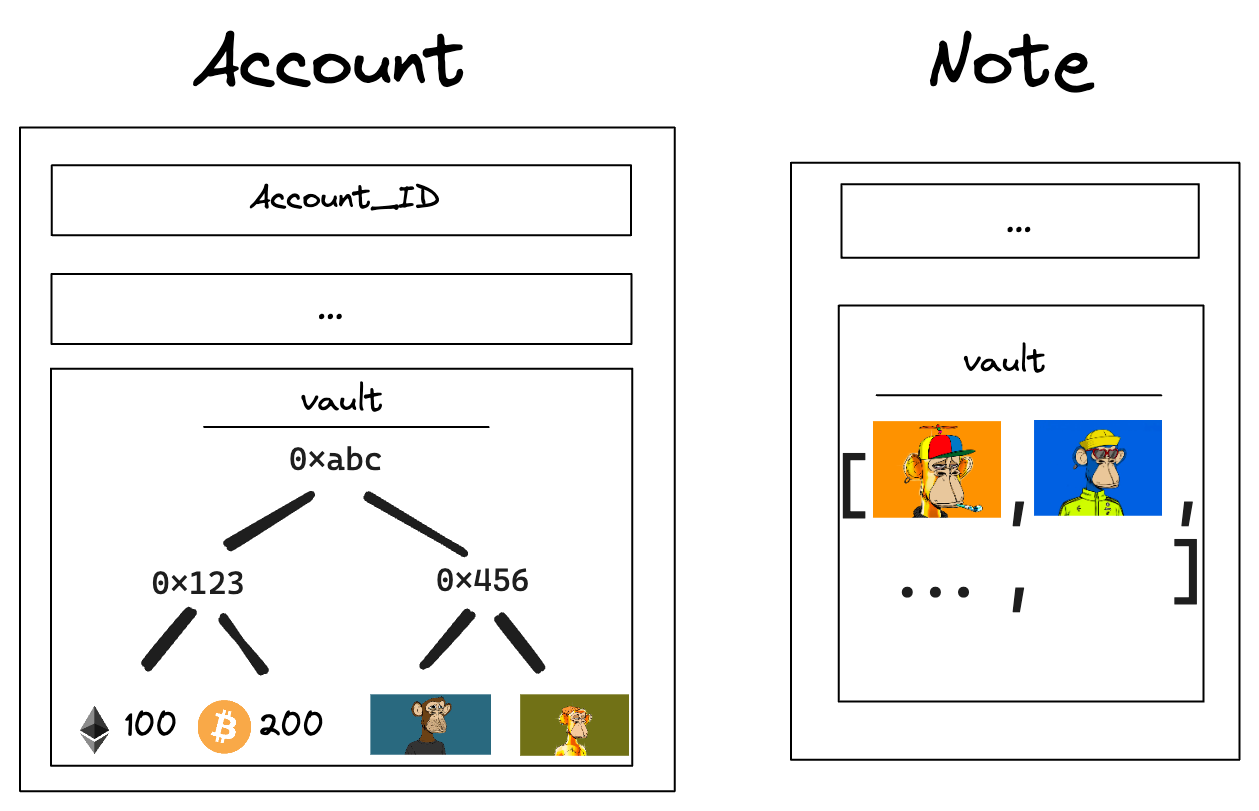
Accounts and notes have vaults used to store assets. Accounts use a sparse Merkle tree as a vault while notes use a simple list. This enables an account to store a practically unlimited number of assets while a note can only store up to 64 assets.
Burning
Assets in Miden can be burned through various methods, such as rendering them unspendable by storing them in an unconsumable note, or sending them back to their original faucet for burning using it's dedicated function.
Callbacks
Asset callbacks allow a faucet to execute custom logic whenever one of its assets is added to an account vault or to an output note. This gives asset issuers a mechanism to enforce policies on their assets. For example, maintaining a block list of accounts that are not allowed to receive the asset or globally pausing transfers of assets.
How callbacks work
Callbacks involve two parts: a per-asset flag and faucet-level callback procedures.
Per-asset callback flag. Every asset carries a single-bit callback flag in its vault key. When the flag is Enabled, the kernel checks for and invokes callbacks on the issuing faucet whenever the asset is added to a vault or note. When the flag is Disabled, callbacks are skipped entirely. This flag is set at asset creation time and the protocol does not prevent issuing assets with different flags from the same faucet. Technically, this gives faucets the ability to issue a callback-enabled and a callback-disabled variant of their assets.
Two assets issued by the same faucet with different callback flags are considered completely different assets by the protocol.
It is recommended that faucets issue all of their assets with the same flag to ensure all assets issued by a faucet are treated as one type of asset. This is ensured when using faucet::create_fungible_asset or faucet::create_non_fungible_asset.
Faucet callback procedures. A faucet registers callbacks by storing the procedure root (hash) of one if its public account procedures in a well-known storage slot. Two callbacks are supported:
| Callback | Storage slot name | Triggered when |
|---|---|---|
on_before_asset_added_to_account | miden::protocol::faucet::callback::on_before_asset_added_to_account | The asset is added to an account's vault (via native_account::add_asset). |
on_before_asset_added_to_note | miden::protocol::faucet::callback::on_before_asset_added_to_note | The asset is added to an output note (via output_note::add_asset). |
Account components that need to add callbacks to an account's storage should use the AssetCallbacks type, which provides an easy-to-use abstraction over these details.
Callback interfaces
The transaction kernel invokes the callback on the issuing faucet and the callback receives the asset key and value and is expected to return the processed asset value.
At this time, the processed asset value must be the same as the asset value, but in the future this limitation may be lifted.
The account callback receives:
Inputs:  [ASSET_KEY, ASSET_VALUE, pad(8)]
Outputs: [PROCESSED_ASSET_VALUE, pad(12)]
The note callback receives the additional note_idx identifying which output note the asset is being added to:
Inputs:  [ASSET_KEY, ASSET_VALUE, note_idx, pad(7)]
Outputs: [PROCESSED_ASSET_VALUE, pad(12)]
Both callbacks are invoked via call, so they must follow the convention of accepting and returning 16 stack elements (input + padding).
Callback skipping
A callback is not invoked in any of these cases:
- The asset's callback flag is
Disabled. - The issuing faucet does not have the corresponding callback storage slot.
- The callback storage slot contains the empty word.
This means assets with callbacks enabled can still be used even if the faucet has not (yet) registered a callback procedure.
Alternative asset models
All data structures not following the Miden asset model that can be exchanged.
Miden is flexible enough to support other Asset models. For example, developers can replicate Ethereum’s ERC20 pattern, where fungible Asset ownership is recorded in a single account. To transact, users send a note to that account, triggering updates in the global hashmap state.