Creating Notes in Miden Assembly
Creating notes inside the MidenVM using Miden assembly
Overview
In this tutorial, we will create a custom note that generates a copy of itself when it is consumed by an account. The purpose of this tutorial is to demonstrate how to create notes inside the MidenVM using Miden assembly (MASM). By the end of this tutorial, you will understand how to write MASM code that creates notes.
What We'll Cover
- Computing the note inputs commitment in MASM
- Creating notes in MASM
Prerequisites
This tutorial assumes you have a basic understanding of Miden assembly and that you have completed the tutorial on creating a custom note.
Why Creating Notes in MASM Is Useful
Being able to create a note in MASM enables you to build various types of applications. Creating a note during the consumption of another note or from an account allows you to develop complex DeFi applications.
Here are some tangible examples of when creating a note in MASM is useful in a DeFi context:
- Creating snapshots of an account's state at a specific point in time (not possible in an EVM context)
- Representing partially fillable buy/sell orders as notes (SWAPP)
- Handling withdrawals from a smart contract
What We Will Be Building
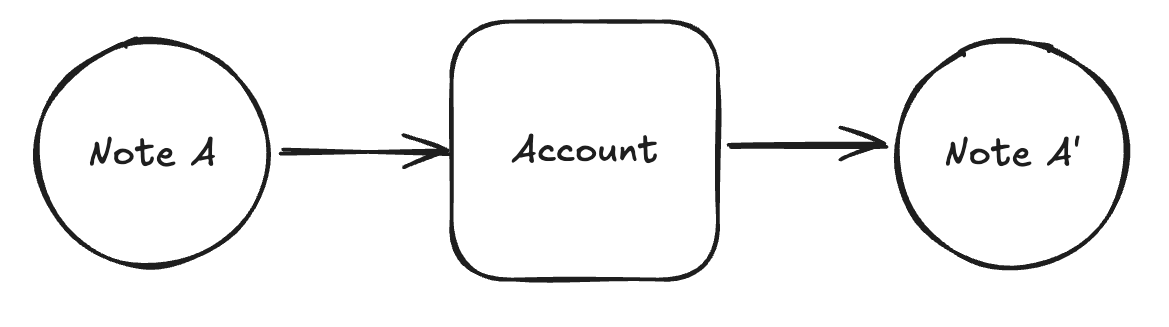
In the diagram above, note A is consumed by an account, and during the transaction, note A' is created.
In this tutorial, we will create a note that contains an asset. When consumed, it outputs a copy of itself and allows the consuming account to take half of the asset. Although this type of note would not be used in a real-world context, it demonstrates several key concepts for writing MASM code that can create notes.
Step 1: Initialize Your Repository
Create a new Rust repository for your Miden project and navigate to it with the following command:
cargo new miden-project
cd miden-project
Add the following dependencies to your Cargo.toml file:
[dependencies]
miden-client = { version = "0.13.0", features = ["testing", "tonic"] }
miden-client-sqlite-store = { version = "0.13.0", package = "miden-client-sqlite-store" }
miden-protocol = { version = "0.13.0" }
rand = { version = "0.9" }
serde = { version = "1", features = ["derive"] }
serde_json = { version = "1.0", features = ["raw_value"] }
tokio = { version = "1.46", features = ["rt-multi-thread", "net", "macros", "fs"] }
rand_chacha = "0.9.0"
Step 2: Write the Note Script
For better code organization, we will separate the Miden assembly code from our Rust code.
Create a directory named masm at the root of your miden-project directory. This directory will contain our contract and MASM script code.
Initialize the masm directory:
mkdir masm/notes
This will create:
masm/
└── notes/
Inside the masm/notes/ directory, create the file iterative_output_note.masm:
use miden::protocol::active_note
use miden::protocol::note
use miden::protocol::output_note
use miden::core::sys
use miden::standards::wallets::basic->wallet

# Memory Addresses
const ASSET=0
const ASSET_HALF=4
const ACCOUNT_ID_PREFIX=8
const TAG=10

# => []
begin
    # Drop word if user accidentally pushes note_args
    dropw
    # => []

    # Get asset contained in note
    push.ASSET exec.active_note::get_assets drop drop
    # => []

    mem_loadw_be.ASSET
    # => [ASSET]

    # Compute half amount of asset
    swap.3 push.2 div swap.3
    # => [ASSET_HALF]

    mem_storew_be.ASSET_HALF dropw
    # => []

    mem_loadw_be.ASSET
    # => [ASSET]

    # Receive the entire asset amount to the wallet
    call.wallet::receive_asset
    # => []

    # Push script hash
    exec.active_note::get_script_root
    # => [SCRIPT_HASH]

    # Get the current note serial number
    exec.active_note::get_serial_number
    # => [SERIAL_NUM, SCRIPT_HASH]

    # Increment serial number by 1
    push.1 add
    # => [SERIAL_NUM+1, SCRIPT_HASH]

    # Load note inputs into memory for recipient and tag
    push.ACCOUNT_ID_PREFIX
    exec.active_note::get_inputs
    # => [num_inputs, dest_ptr, SERIAL_NUM+1, SCRIPT_HASH]

    swap
    # => [dest_ptr, num_inputs, SERIAL_NUM+1, SCRIPT_HASH]

    exec.note::build_recipient
    # => [RECIPIENT]

    # Push note type to stack (public note)
    push.1
    # => [note_type, RECIPIENT]

    # Load tag from memory
    mem_load.TAG
    # => [tag, note_type, RECIPIENT]

    call.output_note::create
    # => [note_idx, pad(15) ...]

    padw mem_loadw_be.ASSET_HALF
    # => [ASSET / 2, note_idx]

    call.wallet::move_asset_to_note
    # => [ASSET, note_idx, pad(11)]

    dropw drop
    # => []

    exec.sys::truncate_stack
    # => []
end
How the Assembly Code Works:
- Retrieving the asset:
The note callsactive_note::get_assetsto write the asset contained in the note to memory address 0, defined asASSET. It computes half of the asset and stores the value at memory address 4, defined asASSET_HALF. Finally, the note calls thewallet::receive_assetprocedure to move the asset contained in the note to the consuming account. - Getting the script hash and serial number:
The note script callsactive_note::get_script_rootto fetch the script hash andactive_note::get_serial_numberto fetch the current serial number, then increments it by 1 to avoid duplicate recipients. - Building the
RECIPIENT:
The script loads the note inputs into memory withactive_note::get_inputs, then callsnote::build_recipient. This computes the inputs commitment and stores the inputs preimage in the advice map, which is required for public notes. - Creating the note:
To create the note, the script pushes the note type and tag onto the stack, then calls theoutput_note::createprocedure, which returns a pointer to the note. - Moving assets to the note:
After the note is created, the script loads the half asset value computed in step 1 onto the stack and calls thewallet::move_asset_to_noteprocedure. - Stack cleanup:
Finally, the script cleans up the stack by callingsys::truncate_stackafter creating the note and adding the assets.
Step 3: Rust Program
With the Miden assembly note script written, we can move on to writing the Rust script to create and consume the note.
Copy and paste the following code into your src/main.rs file.
use miden_client::auth::AuthFalcon512Rpo;
use rand::RngCore;
use std::{fs, path::Path, sync::Arc};
use tokio::time::{sleep, Duration};

use miden_client::{
    account::{
        component::{BasicFungibleFaucet, BasicWallet},
        Account,
    },
    address::NetworkId,
    asset::{FungibleAsset, TokenSymbol},
    auth::AuthSecretKey,
    builder::ClientBuilder,
    crypto::FeltRng,
    keystore::FilesystemKeyStore,
    note::{
        Note, NoteAssets, NoteInputs, NoteMetadata, NoteRecipient, NoteTag, NoteType,
    },
    rpc::{Endpoint, GrpcClient},
    transaction::{OutputNote, TransactionRequestBuilder},
    Client, ClientError, Felt,
};
use miden_client_sqlite_store::ClientBuilderSqliteExt;
use miden_client::{
    account::{AccountBuilder, AccountStorageMode, AccountType},
    note::NoteDetails,
};

// Helper to create a basic account
async fn create_basic_account(
    client: &mut Client<FilesystemKeyStore>,
    keystore: &Arc<FilesystemKeyStore>,
) -> Result<Account, ClientError> {
    let mut init_seed = [0u8; 32];
    client.rng().fill_bytes(&mut init_seed);

    let key_pair = AuthSecretKey::new_falcon512_rpo();

    let account = AccountBuilder::new(init_seed)
        .account_type(AccountType::RegularAccountUpdatableCode)
        .storage_mode(AccountStorageMode::Public)
        .with_auth_component(AuthFalcon512Rpo::new(key_pair.public_key().to_commitment()))
        .with_component(BasicWallet)
        .build()
        .unwrap();

    client.add_account(&account, false).await?;
    keystore.add_key(&key_pair).unwrap();

    Ok(account)
}

async fn create_basic_faucet(
    client: &mut Client<FilesystemKeyStore>,
    keystore: &Arc<FilesystemKeyStore>,
) -> Result<Account, ClientError> {
    let mut init_seed = [0u8; 32];
    client.rng().fill_bytes(&mut init_seed);

    let key_pair = AuthSecretKey::new_falcon512_rpo();
    let symbol = TokenSymbol::new("MID").unwrap();
    let decimals = 8;
    let max_supply = Felt::new(1_000_000);

    let account = AccountBuilder::new(init_seed)
        .account_type(AccountType::FungibleFaucet)
        .storage_mode(AccountStorageMode::Public)
        .with_auth_component(AuthFalcon512Rpo::new(key_pair.public_key().to_commitment()))
        .with_component(BasicFungibleFaucet::new(symbol, decimals, max_supply).unwrap())
        .build()
        .unwrap();

    client.add_account(&account, false).await?;
    keystore.add_key(&key_pair).unwrap();

    Ok(account)
}

// Helper to wait until an account has the expected number of consumable notes
async fn wait_for_notes(
    client: &mut Client<FilesystemKeyStore>,
    account_id: &Account,
    expected: usize,
) -> Result<(), ClientError> {
    loop {
        client.sync_state().await?;
        let notes = client.get_consumable_notes(Some(account_id.id())).await?;
        if notes.len() >= expected {
            break;
        }
        println!(
            "{} consumable notes found for account {}. Waiting...",
            notes.len(),
            account_id.id().to_bech32(NetworkId::Testnet)
        );
        sleep(Duration::from_secs(3)).await;
    }
    Ok(())
}

#[tokio::main]
async fn main() -> Result<(), ClientError> {
    // Initialize client
    let endpoint = Endpoint::testnet();
    let timeout_ms = 10_000;
    let rpc_client = Arc::new(GrpcClient::new(&endpoint, timeout_ms));

    // Initialize keystore
    let keystore_path = std::path::PathBuf::from("./keystore");
    let keystore = Arc::new(FilesystemKeyStore::new(keystore_path).unwrap());

    let store_path = std::path::PathBuf::from("./store.sqlite3");

    let mut client = ClientBuilder::new()
        .rpc(rpc_client)
        .sqlite_store(store_path)
        .authenticator(keystore.clone())
        .in_debug_mode(true.into())
        .build()
        .await?;

    let sync_summary = client.sync_state().await.unwrap();
    println!("Latest block: {}", sync_summary.block_num);

    // -------------------------------------------------------------------------
    // STEP 1: Create accounts and deploy faucet
    // -------------------------------------------------------------------------
    println!("\n[STEP 1] Creating new accounts");
    let alice_account = create_basic_account(&mut client, &keystore).await?;
    println!(
        "Alice's account ID: {:?}",
        alice_account.id().to_bech32(NetworkId::Testnet)
    );
    let bob_account = create_basic_account(&mut client, &keystore).await?;
    println!(
        "Bob's account ID: {:?}",
        bob_account.id().to_bech32(NetworkId::Testnet)
    );

    println!("\nDeploying a new fungible faucet.");
    let faucet = create_basic_faucet(&mut client, &keystore).await?;
    println!(
        "Faucet account ID: {:?}",
        faucet.id().to_bech32(NetworkId::Testnet)
    );
    client.sync_state().await?;

    // -------------------------------------------------------------------------
    // STEP 2: Mint tokens with P2ID
    // -------------------------------------------------------------------------
    println!("\n[STEP 2] Mint tokens with P2ID");
    let faucet_id = faucet.id();
    let amount: u64 = 100;
    let mint_amount = FungibleAsset::new(faucet_id, amount).unwrap();

    let tx_req = TransactionRequestBuilder::new()
        .build_mint_fungible_asset(
            mint_amount,
            alice_account.id(),
            NoteType::Public,
            client.rng(),
        )
        .unwrap();

    let tx_id = client.submit_new_transaction(faucet.id(), tx_req).await?;
    println!("Minted tokens. TX: {:?}", tx_id);

    wait_for_notes(&mut client, &alice_account, 1).await?;

    // Consume the minted note
    let consumable_notes = client
        .get_consumable_notes(Some(alice_account.id()))
        .await?;

    if let Some((note_record, _)) = consumable_notes.first() {
        let note: Note = note_record.clone().try_into()?;
        let consume_req = TransactionRequestBuilder::new().build_consume_notes(vec![note])?;

        let tx_id = client
            .submit_new_transaction(alice_account.id(), consume_req)
            .await?;
        println!("Consumed minted note. TX: {:?}", tx_id);
    }

    client.sync_state().await?;

    // -------------------------------------------------------------------------
    // STEP 3: Create iterative output note
    // -------------------------------------------------------------------------
    println!("\n[STEP 3] Create iterative output note");

    let code = fs::read_to_string(Path::new("../masm/notes/iterative_output_note.masm")).unwrap();
    let serial_num = client.rng().draw_word();

    // Create note metadata and tag
    let tag = NoteTag::new(0);
    let metadata = NoteMetadata::new(alice_account.id(), NoteType::Public, tag);
    let note_script = client.code_builder().compile_note_script(&code).unwrap();
    let note_inputs = NoteInputs::new(vec![
        alice_account.id().prefix().as_felt(),
        alice_account.id().suffix(),
        tag.into(),
        Felt::new(0),
    ])
    .unwrap();

    let recipient = NoteRecipient::new(serial_num, note_script.clone(), note_inputs.clone());
    let vault = NoteAssets::new(vec![mint_amount.into()])?;
    let custom_note = Note::new(vault, metadata, recipient);

    let note_req = TransactionRequestBuilder::new()
        .own_output_notes(vec![OutputNote::Full(custom_note.clone())])
        .build()
        .unwrap();

    let tx_id = client
        .submit_new_transaction(alice_account.id(), note_req)
        .await?;
    println!(
        "View transaction on MidenScan: https://testnet.midenscan.com/tx/{:?}",
        tx_id
    );

    client.sync_state().await?;

    // -------------------------------------------------------------------------
    // STEP 4: Consume the iterative output note
    // -------------------------------------------------------------------------
    println!("\n[STEP 4] Bob consumes the note and creates a copy");

    // Increment the serial number for the new note
    let serial_num_1 = [
        serial_num[0],
        serial_num[1],
        serial_num[2],
        Felt::new(serial_num[3].as_int() + 1),
    ]
    .into();

    // Reuse the note_script and note_inputs
    let recipient = NoteRecipient::new(serial_num_1, note_script, note_inputs);

    // Note: Change metadata to include Bob's account as the creator
    let metadata = NoteMetadata::new(bob_account.id(), NoteType::Public, tag);

    let asset_amount_1 = FungibleAsset::new(faucet_id, 50).unwrap();
    let vault = NoteAssets::new(vec![asset_amount_1.into()])?;
    let output_note = Note::new(vault, metadata, recipient);

    let consume_custom_req = TransactionRequestBuilder::new()
        .input_notes([(custom_note, None)])
        .expected_future_notes(vec![(
            NoteDetails::from(output_note.clone()),
            output_note.metadata().tag(),
        )
            .clone()])
        .expected_output_recipients(vec![output_note.recipient().clone()])
        .build()
        .unwrap();

    let tx_id = client
        .submit_new_transaction(bob_account.id(), consume_custom_req)
        .await?;
    println!(
        "Consumed Note Tx on MidenScan: https://testnet.midenscan.com/tx/{:?}",
        tx_id
    );

    Ok(())
}
Run the following command to execute src/main.rs:
cargo run --release
The output will look something like this:
Latest block: 226933

[STEP 1] Creating new accounts
Alice's account ID: "mtst1qpljtarjtawzcyqqqdcqu53adytw09yw"
Bob's account ID: "mtst1qzaynsxth84vsyqqq0emse6ygcax3j59"

Deploying a new fungible faucet.
Faucet account ID: "mtst1qpqpq6z8vrqvugqqqwjdnajgvurs9zgl"

[STEP 2] Mint tokens with P2ID
0 consumable notes found for account mtst1qpljtarjtawzcyqqqdcqu53adytw09yw. Waiting...
0 consumable notes found for account mtst1qpljtarjtawzcyqqqdcqu53adytw09yw. Waiting...

[STEP 3] Create iterative output note
View transaction on MidenScan: https://testnet.midenscan.com/tx/0x335061a434ccccbf9619052bdeacbc71b6e755b24f0ead0c3741a3b0954c78af

[STEP 4] Bob consumes the note and creates a copy
Consumed Note Tx on MidenScan: https://testnet.midenscan.com/tx/0xa39acf2bb965b4669b91bf564e8aa2987a9fc86ee350cd159ad5db1054cb67ab
Account delta: AccountVaultDelta { fungible: FungibleAssetDelta({V0(Accoun
Running the example
To run the full example, navigate to the rust-client directory in the miden-tutorials repository and run this command:
cd rust-client
cargo run --release --bin note_creation_in_masm
Continue learning
Next tutorial: Delegated Proving